2026 IMS | IASO Bio Presented FUCASO China Real-World Data
--- In a large China real-world study of 281 heavily pretreated, predominantly high-risk patients with relapsed/refractory plasma cell neoplasms, FUCASO achieved a 95.9% objective response rate, a 77.2% CR/sCR rate, and a 94.1% MRD negativity rate
--- with median PFS and OS not yet reached (12-month PFS 71.5%, OS 87.8%) and consistent benefit across high-risk subgroups, validating the efficacy of the pivotal registration study in real-world practice
SHANGHAI, NANJING, and PLEASANTON, CA—Sep 26, 2026—IASO Biotechnology (“IASO Bio”), a commercial-stage biopharmaceutical company focused on the discovery, development, manufacturing, and commercialization of novel cell therapies and biologics for hematologic malignancies and autoimmune diseases ,announced that results from a China real-world study (RWS) of its self-developed, world’s first fully human BCMA-targeting CAR-T cell therapy product — FUCASO (equecabtagene autoleucel injection, Eque-cel) — for the treatment of relapsed/refractory plasma cell neoplasms were formally presented at the 2026 International Myeloma Society (IMS) Annual Meeting, and reported by Professor Jin Lu of Peking University People’s Hospital as an oral presentation at the meeting (Abstract No.: OA-09).1
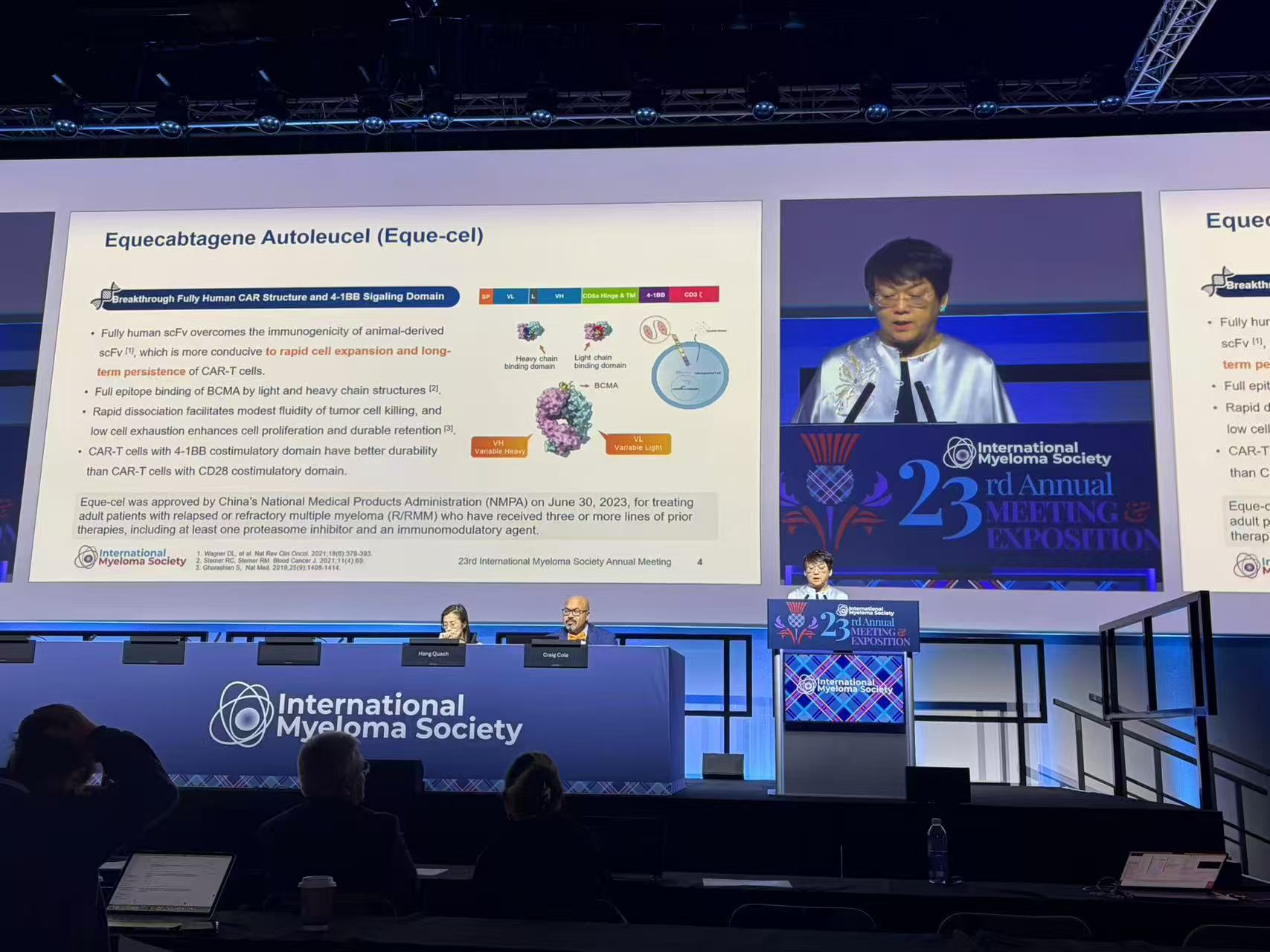
On September 26 local time, Professor Jin Lu delivered an oral presentation at the IMS Annual Meeting in Glasgow, UK.
Real-World Patient Population: Heavily Pretreated, with Prominent High-Risk Features
This multicenter real-world study enrolled 281 patients with plasma cell neoplasms treated at multiple centers across China since the launch of FUCASO in June 2023.
Enrolled patients had a median age of 61 years (range 30–82 years; 18.7% ≥70 years) and a median of 4 prior lines of therapy, up to a maximum of 12 lines. 84.0% had received prior anti-CD38 therapy, 27.4% were penta-exposed, and 46.9% had previously undergone autologous stem cell transplantation (ASCT); meanwhile, 82.4% had any high-risk cytogenetic abnormality (HRCA), 50.5% were ISS stage III, 7.8% had plasma cell leukemia (PCL), and 47.0% had extramedullary disease (EMD) of varying degrees.
Deep and Durable Responses
Among the 267 efficacy-evaluable patients, FUCASO demonstrated a dual response profile. In terms of depth of response, the objective response rate (ORR) reached 95.9%, with a complete response (CR) or stringent complete response (sCR) rate of 77.2% (sCR rate 42.7%), a very good partial response or better (≥VGPR) rate of 86.9%, and 94.1% of patients achieved minimal residual disease (MRD) negativity. In terms of durability of response, at a median follow-up of 10.97 months, neither median progression-free survival (mPFS) nor median overall survival (mOS) had been reached; the 12-month PFS rate was 71.5% and the 12-month OS rate was 87.8%. Beyond deep and durable responses, these real-world data further corroborate the efficacy and safety demonstrated in the pivotal registration study.
Efficacy of the Pivotal Registration Study Validated in Real-World Practice
Across multiple high-risk subgroups, 12-month PFS rates were comparable to those of the overall cohort, with no additional increase observed in the incidence of grade ≥3 CRS or ICANS: in patients aged >70 years (n=35), the ORR was 94.3% and the 12-month PFS rate was 69.6%; in patients previously treated with anti-CD38 therapy, the ORR was 96.0% and the 12-month PFS rate was 68.5%; in CGS-defined high-risk patients (94/177), the ORR was 98.9% and the 12-month PFS rate was 65.1%.
Clear Real-World Safety Boundaries, with Risks Generally Manageable
The incidence of any-grade cytokine release syndrome (CRS) was 88.2%, of which only 3.8% was grade ≥3; the incidence of any-grade immune effector cell-associated neurotoxicity syndrome (ICANS) was 6.8%; no parkinsonism was observed.
In addition, the study further conducted a stratified analysis of patients at high risk per the CAR-HEMATOTOX (CAR-HT) score. The results showed that high-risk patients had a lower 12-month PFS rate than low-risk patients (60.3% vs 86.9%), as well as higher incidences of grade ≥3 CRS (6.5%) and ICANS (9.7%). These findings suggest that enhanced safety management and treatment support are warranted for high-risk patients in real-world settings.
Conclusion
Data from this China real-world study show that FUCASO delivers deep and durable responses together with a favorable safety profile in heavily pretreated, high-risk patients with relapsed/refractory plasma cell neoplasms, with consistent benefit across subgroups including elderly patients, those previously treated with anti-CD38 therapy, and those with high-risk cytogenetics — further validating, in real-world practice, efficacy and safety consistent with those of the pivotal registration study.
Professor Jin Lu
Peking University People’s Hospital
“We are very pleased to present data from the China real-world study of FUCASO at this year’s IMS Annual Meeting. Compared with the registration study population, real-world patients were generally higher-risk and more heavily pretreated, with a higher proportion presenting poor prognostic features such as extramedullary disease or plasma cell leukemia; nevertheless, FUCASO still achieved an objective response rate (ORR) of 95.9% and a complete response (CR) or stringent complete response (sCR) rate of 77.2%, with efficacy consistent with the overall cohort across the elderly, prior anti-CD38-treated, and high-risk cytogenetic subgroups. Median PFS has not yet been reached in this study, further confirming the deep and durable efficacy and broad applicability of FUCASO® in real-world clinical practice.”
Reference:
1. Lu J, An G, Jin J, et al. BCMA CAR T-Cell Therapy (Equecabtagene Autoleucel, Eque-cel) for Multiple Myeloma in Chinese Clinical Practice: A Large Real-World Evidence of 281 Patients. 2026 IMS. Oral Abstract OA-09.